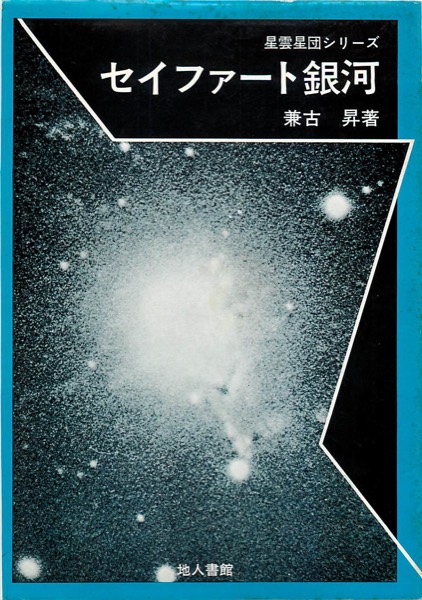
Seyfert Galaxies
セイファート銀河
FREE FULL TEXTAbout this book
This book is a textbook of observational astronomy, treating Seyfert galaxies systematically from the observational side. Seyfert galaxies are the galaxies that show the most typical form of activity in their nuclei, yet at the time this book was written no single volume had been devoted to them: the subject appeared only as fragments of a few pages inside general works on astronomy. This book was written to fill that gap.
It traces the discovery of activity in galactic nuclei from the nucleus of the Andromeda Galaxy through Seyfert's own observations to the discovery of quasars; sets out how Seyfert galaxies are defined, searched for and catalogued; and then examines individual objects — NGC 1068, NGC 4151, NGC 1275, 3C 120 and others — in morphological detail, alongside the peculiar galaxies M 82, M 87 and NGC 5128.
The later chapters form the core of the book. They follow how Seyfert galaxies are actually observed, wavelength band by wavelength band, building up in turn what is observed in each and what can be read from it: emission-line spectra and their profiles and line-broadening mechanisms, the visible and ultraviolet continuum, infrared radiation, radio, and X-rays. The final chapter gathers this evidence and weighs the models proposed for the energy source, including accretion models and the question of how nuclear activity originates.
The extensive reference list and the catalog of Seyfert galaxies at the end serve as working apparatus for readers going on to observe or research the subject themselves.
Preface
The discovery of activity in galactic nuclei is one of the greatest achievements of modern astronomy, and Seyfert galaxies — the subject of our research — are known as the objects that display the most typical nuclear activity of all.
The astronomical term “Seyfert galaxy” has become fairly widely known in recent years, but the material presented about them is clearly fragmentary. It is fortunate if even a few pages of an astronomy book are allotted to the subject. Yet the problems that Seyfert galaxies pose are not simple enough to be explained in a few pages. Seyfert galaxies are an independent field of research in their own right, and at the same time they are deeply connected with radio galaxies and quasars, and further with the formation and evolution of galaxies. Considering this importance of Seyfert galaxies, I do not think I am the only one who feels that the fact that not a single book has been published dealing with them leaves our astronomical knowledge unbalanced. In this sense, the addition of Seyfert galaxies to this series — quite apart from whether the author is the right person to write this volume — can be called a meaningful undertaking for the popularization of galactic astronomy. If this book can fill a blank field, nothing would give me greater pleasure.
I offer my heartfelt thanks to Mr. Ichikawa Masanori [市川正徳] of Chijin Shokan, who took care of the publication of this book; to Professor Ōno Yōrō [大野陽朗] and Professor Sakashita Shirō [坂下志郎], who continued to encourage me over these three years; to everyone in the Astrophysics Laboratory at Hokkaido University; and — though it is a personal matter — to my wife as well.
March 1982 / KANEKO Noboru [兼古 昇]
Contents
-
I. The Discovery of Activity in Galactic Nuclei
- The nucleus of the Andromeda Galaxy
- Nuclei with emission-line spectra
- Seyfert’s observations
- Radio galaxies and galactic nuclei
- The discovery of quasars
- Research on Seyfert galaxies
-
II. Catalogs of Seyfert Galaxies
- The definition of a Seyfert galaxy
- Searches for Seyfert galaxies and Markarian galaxies
- Peculiar galaxies found to be Seyfert galaxies
- Catalogs of Seyfert galaxies
-
III. Morphology I. Seyfert Galaxies
- NGC 1068
- NGC 4151
- NGC 3516 and NGC 3783
- NGC 3227 and NGC 7469
- NGC 1275
- 3C 120 and 3C 390.3
-
IV. Morphology II. Peculiar Galaxies
- M 82
- M 87
- NGC 5128 and NGC 1316
- Quasars
- V. Morphology III. Characteristics of Seyfert Galaxies
-
VI. Emission-Line Spectra
- Type 1 and type 2 emission-line spectra
- Absolute luminosities of the emission lines
- Interpretation of the emission-line spectra
- Emission-line profiles
- Line-broadening mechanisms
- Variability of the line spectra
-
VII. Visible and Ultraviolet Continuum
- Spectral distribution
- The nuclear continuum
- Light variation
- Polarization
- Radiation mechanisms of the continuum
-
VIII. Infrared Radiation
- The infrared continuum
- Emission lines and Si absorption
- Variability and polarization
- Radiation mechanisms of the infrared
-
IX. Radio
- Continuum spectra
- Line spectra
-
X. X-rays
- Peculiar galaxies that emit X-rays
- X-rays from Seyfert galaxies
- Intensity variations
- Radiation mechanisms of the X-rays
-
XI. The Energy Source
- Summary of the observations
- Various models of galactic nuclei
- Accretion models
- The origin of nuclear activity
- References
- Catalog of Seyfert Galaxies
Download
The book is made available with the consent of the author and the permission of the publisher, Chijin Shokan. More than forty years have passed since publication and there are no plans to reissue it. You are free to download it for educational and research purposes.
The English edition was translated from the Japanese original with the help of AI, and has not been checked line by line by a human translator. Where precision matters — equations, figures, cited values — please refer to the Japanese edition, or to the original scan, which reproduces the printed pages exactly but carries no searchable text.
For commercial use of this data, or to republish it elsewhere, please write to the address below.